Safer Sedation Airway Management Is Possible with the AERIS Airway™
Providing effective supplemental oxygen during procedural sedation is crucial to prevent hypoxia and its potentially serious consequences.
Unfortunately, hypoxia during procedural sedation is a common occurrence. A retrospective cohort study involving 5,993 adult patients revealed that 29% developed hypoxemia during moderate to deep sedation. The risk was significantly higher during longer procedures. [1]
To help detect such respiratory complications, the American Society of Anesthesiologists 2025 guidelines recommend continuous end-tidal CO₂ monitoring during moderate to deep sedation.
Currently, during I.V. sedation, anesthesia providers typically use oxygen masks or nasal cannulas to deliver oxygen and monitor CO₂. However, both devices result in inferior oxygen delivery and provide unreliable end-tidal CO₂ (ETCO₂) readings due to gas mixture and dilution.
AERIS TRANSFORMS STANDARD SEDATION AIRWAYS INTO HIGHLY EFFICIENT O₂ DELIVERY AND ETCO₂ MONITORING SYSTEMS
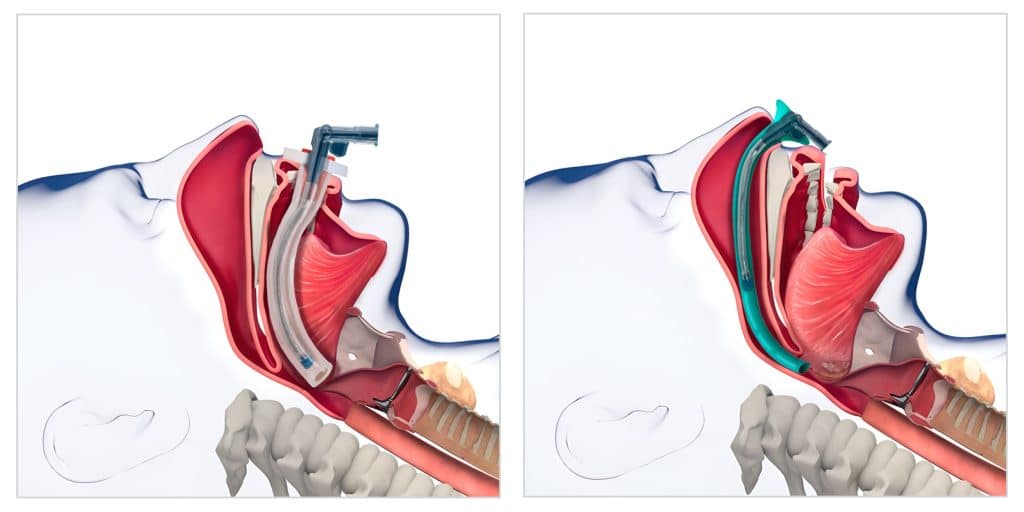
The AERIS Airway™ from Airway Innovations™ modernizes the practice of deep sedation and limits the risk of hypoxia in patients. The AERIS Airway transforms any standard Guedel-type oropharyngeal (OPA) or nasopharyngeal (NPA) into a highly efficient oxygen delivery and ETCO₂ monitoring system in seconds.
By offsetting the oxygen delivery port from the CO₂ detection port, end-tidal CO₂ is captured at the supraglottis with minimal oxygen dilution, generating a real-time, reliable CO₂ waveform on all clinical capnography monitors.
AERIS OUTPERFORMS DIVIDED NASAL CANNULAS AND OXYGEN FACE MASKS
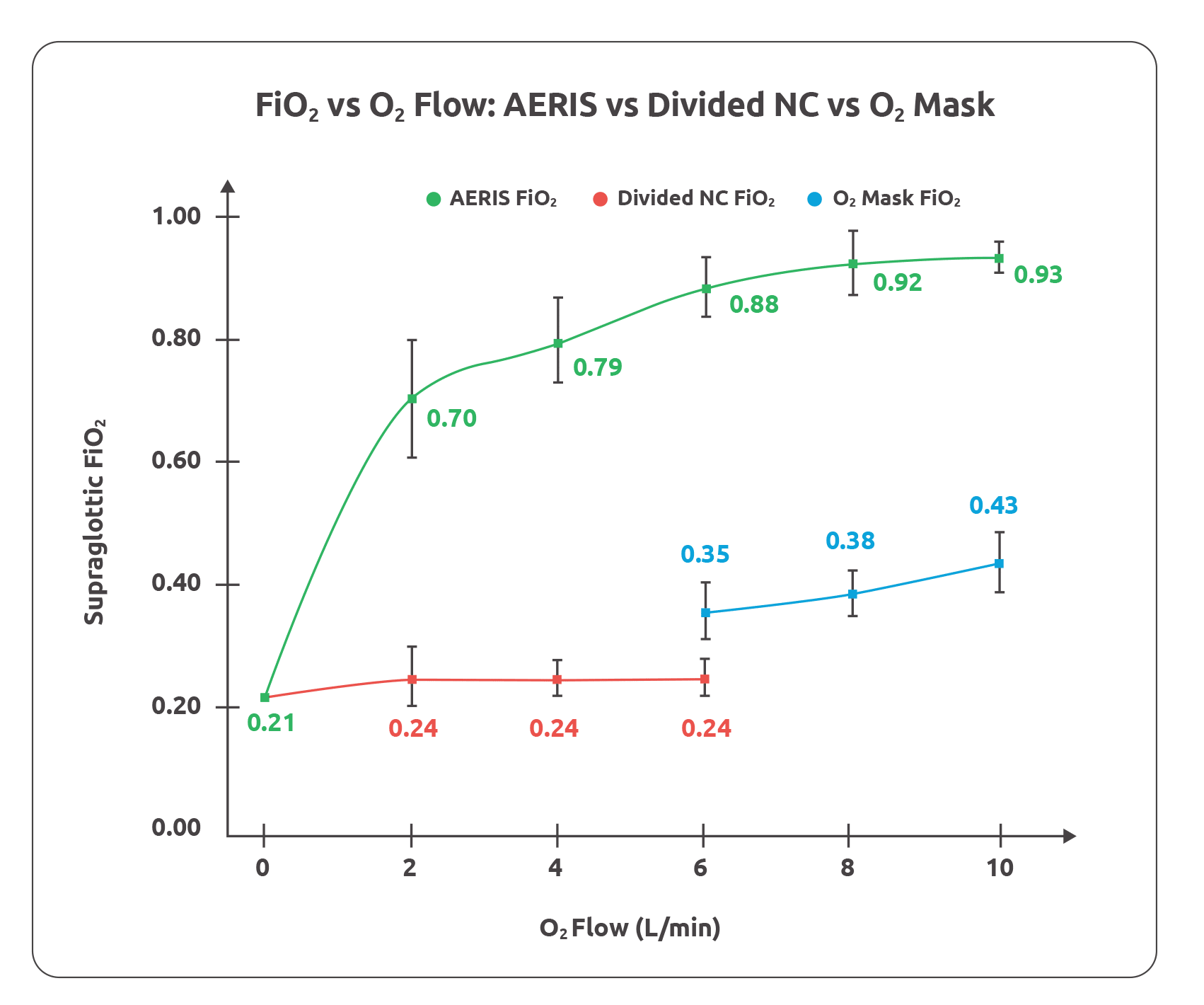
A recent White Paper compared supraglottic FiO₂ provided by oxygen masks, nasal cannulas and the AERIS Airway. The crossover study found that the AERIS delivered two to three times higher FiO₂ to the supraglottic space than the divided nasal cannula or oxygen face mask.[2]

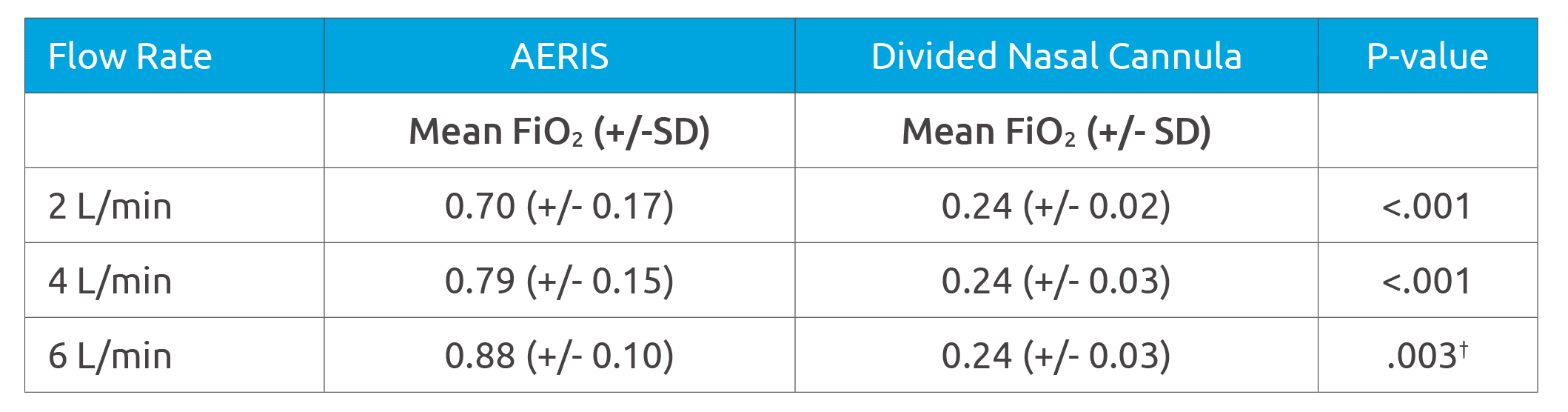
The study concluded that the “AERIS device represents an effective, efficient oxygen delivery system, providing high supraglottic FiO₂ even at relatively low fresh oxygen flow rates for patients undergoing deep or even moderate-to-deep procedural sedation when a nasopharyngeal or Guedel oropharyngeal airway is being used.”
Review the entire White Paper here.
AERIS: BETTER OXYGENATION, MORE RELIABLE CO₂ MONITORING, SAFER SEDATION
Unlike nasal cannulas and face masks that plateau at 21-45% FIO₂, the AERIS Airway™ achieves 80-90% FIO₂ at lower oxygen flow rates of 2-4 L/min.
This superior oxygenation increases patient safety by pre-emptively detecting respiratory compromise and reducing the risk of hypoxemia.
For more information or a demonstration of the AERIS Airway, contact your local MED Alliance Group sales representative, call 888-891-1200 or email us.
MED Alliance Group is a medical device distributor dedicated to meeting the needs of our clinical customers and manufacturing partners since 1998. We specialize in the sales, marketing, importation, logistics and distribution of innovative, high-quality and cost-effective products found in anesthesia and respiratory, blood and transfusion therapy, EMS and emergency room, interventional radiology and cath lab, iv and vascular, as well as NICU and PICU.
Please follow us on LinkedIn, Facebook and Twitter for MED Alliance product updates.
References:
[1] Van Schaik, E. P. C., Blankman, P., Van Klei, W. A., Knape, H. J. T. A., Vaessen, P. H. H. B., Braithwaite, S. A., van Wolfswinkel, L., & Schellekens, W.-J. M. (2021). Hypoxemia during procedural sedation in adult patients: A retrospective observational study. Canadian Journal of Anesthesia, Advance online publication. https://doi.org/10.1007/s12630-021-01992-6. Click here to view.
[2] Gonzalez, R. M. (2025). A comparison of supraglottic FiO₂provided by three oxygen delivery systems: Divided nasal cannula vs. simple oxygen face mask vs. the new AERIS Airway™ device for sedation. Renaissance Medical Consulting. Click here to view.


