From “MacGyvering” to Standardizing: AERIS Airway® Solves the Clinical Gap in Deep IV Sedation Airway Management
Clinicians Often Improvise In Response to a Clinical Gap
If you grew up watching MacGyver, you remember the premise: when faced with a problem, he would create a makeshift solution from whatever was available. In medicine, anesthesiologists and CRNAs occasionally find themselves doing something similar. Faced with a challenging or escalating deep IV sedation airway, they often improvise, modify, or combine existing devices to solve problems that standard oxygen delivery methods were never designed to address.
These clinicians are responding to a clinical gap.
As deep IV sedation becomes increasingly common in non-operating room anesthesia (NORA) settings, anesthesia providers are caring for more patients with obesity, obstructive sleep apnea (OSA), difficult airway anatomy, and other risk factors that increase the likelihood of airway obstruction and respiratory compromise. The stakes are significant. Catastrophic respiratory events remain a major concern during sedation, and NORA claims are associated with a higher proportion of severe outcomes, including brain injury and death.
When a routine sedation case begins to drift toward airway obstruction, providers often discover that a nasal cannula or face mask alone does not provide enough support. Yet the patient may not require escalation to a supraglottic airway or endotracheal intubation. This creates a gray zone in airway management, and clinicians have spent years developing workarounds.
Improvised techniques often used to bridge the gap may include:
- Threading oxygen tubing through an oral airway
- Inserting angiocatheters into nasopharyngeal airways
- Taping nasal cannulas to airway adjuncts
- Using Berman Airways primarily because their design can accommodate oxygen tubing or ETCO₂ sampling lines
- Creating homemade systems to improve oxygen delivery and capnography monitoring
These approaches have a common goal: to maintain airway patency, deliver oxygen closer to the airway, obtain more reliable capnography, and create a more stable airway setup. In other words, clinicians are trying to solve the same problem repeatedly using devices not specifically designed for that purpose.
This phenomenon is perhaps most evident with the use of Berman airways during deep sedation. Originally designed to facilitate the passage of suction catheters and fiberoptic scopes, Berman airways are often repurposed to route oxygen tubing or ETCO₂ sampling lines through their side channels. While effective as a workaround, it remains a makeshift adaptation rather than a purpose-built solution.
Clinicians have modified these devices because they have identified an unmet clinical need. They are attempting to accomplish three essential objectives simultaneously: keep the airway open, optimize oxygenation, and continuously monitor ventilation.
The AERIS Airway® Bridges the Clinical Gap in the Airway Continuum By Providing a Standardized Solution
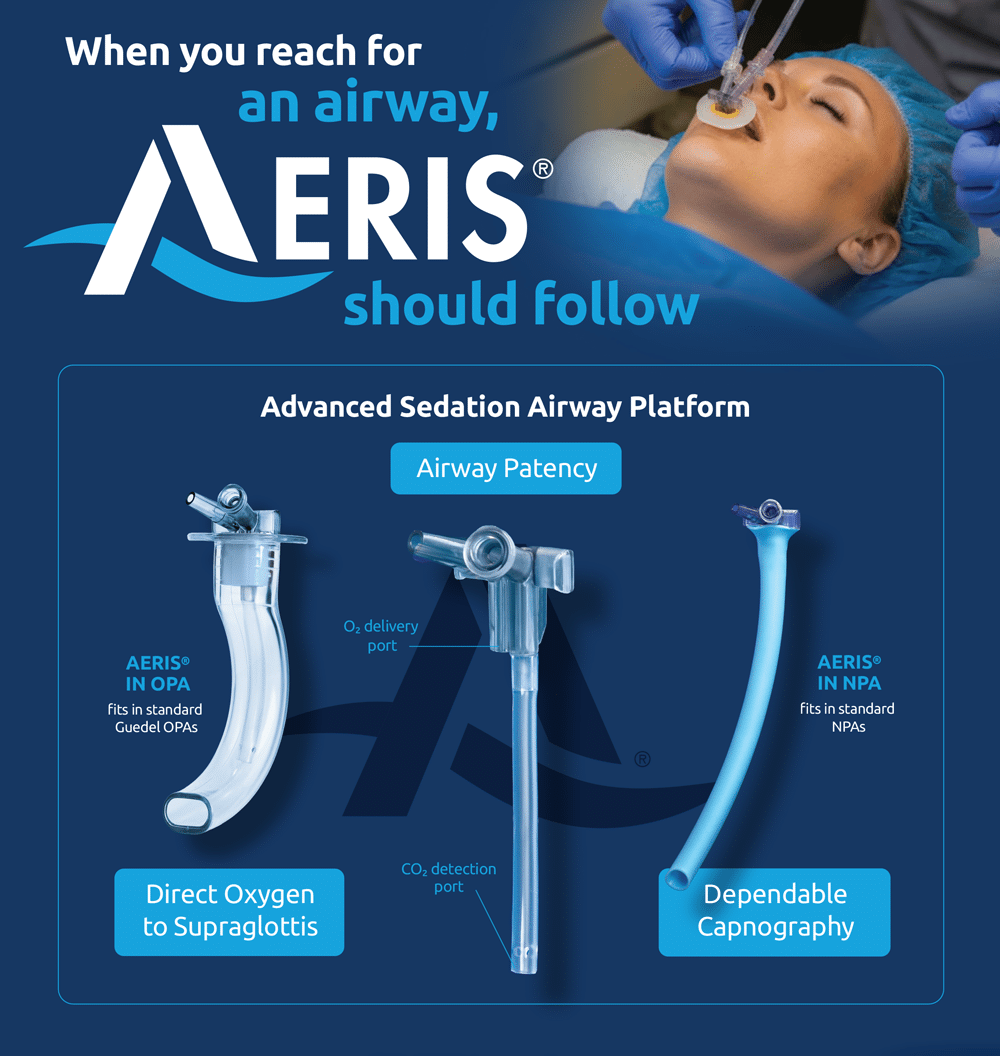
Rather than asking providers to change their airway management strategy, AERIS integrates with the oral and nasopharyngeal airways they already use. The platform was developed to transform familiar airway adjuncts into a dedicated oxygen-delivery and capnography system while maintaining airway patency. The goal is to provide a standardized, reproducible solution instead of relying on improvised configurations that may vary from clinician to clinician.
AERIS represents the missing step in the airway continuum. It is not intended to replace a nasal cannula for every patient, nor is it designed to compete with more invasive rescue airways. Instead, it fills the space between basic oxygen delivery devices and more advanced airway interventions.
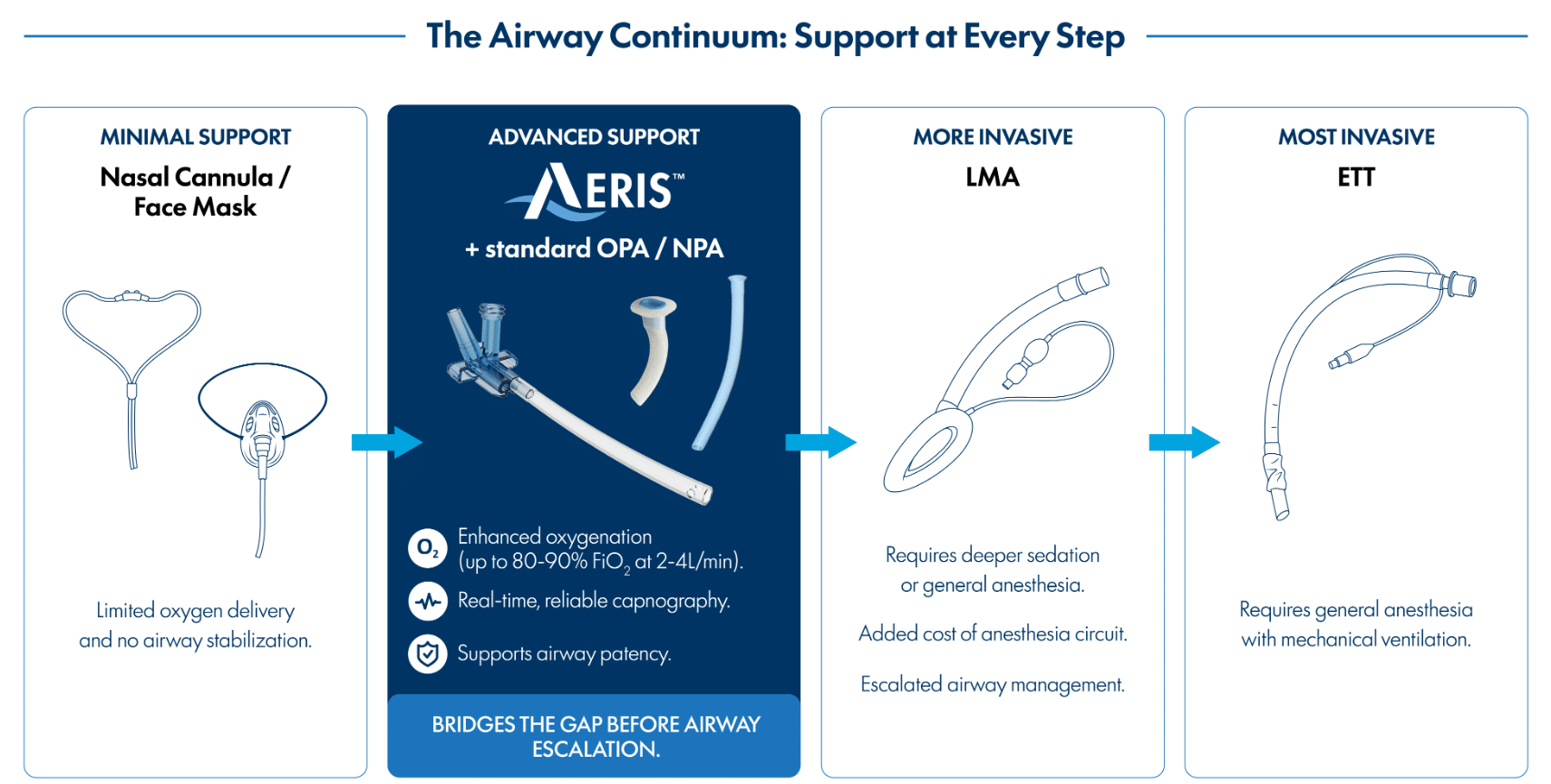
For patients with higher BMI, OSA, anticipated airway obstruction, longer procedures, increased sedative requirements, or other risk factors, providers often need more support than a nasal cannula or face mask can provide. Those are the cases where airway management becomes increasingly challenging and where clinicians often begin “MacGyvering” solutions.
When clinicians repeatedly modify equipment to achieve better oxygenation, more dependable ETCO₂ monitoring, and improved airway stability, they are signaling that existing options do not fully meet their needs.
AERIS was created to address that need with a purpose-built, standardized step-up airway solution for patients undergoing deep IV sedation who require additional airway support. Instead of improvisation, it offers consistency. Instead of a workaround, it provides a dedicated platform. And instead of waiting for an airway challenge to escalate, it gives providers another option to proactively support oxygenation, ventilation, and airway patency when it matters most.
For more information or a demonstration of the AERIS Airway, contact your local MED Alliance Group sales representative, call 888-891-1200 or email us.
MED Alliance Group has been a medical device distributor dedicated to meeting the needs of our clinical customers and manufacturing partners since 1998. We specialize in the sales, marketing, importation, logistics, and distribution of innovative, high-quality, and cost-effective products for anesthesia and respiratory care, blood and transfusion therapy, EMS and emergency room, interventional radiology and cath lab, IV and vascular, as well as NICU and PICU.
Please follow us on LinkedIn, Facebook and Twitter for MED Alliance product updates.


