
ButterflyBVM™ – Designed to Prevent the Five Cascades of Harm in Manual Ventilation
Manual Ventilation: The Hidden Risk in Critical Care
Bag-valve-mask (BVM) ventilation is one of the most commonly performed interventions in emergency and critical care. It is also one of the most deceptively difficult. Clinicians must continuously manage three critical variables simultaneously: ventilation rate, tidal volume, and airway pressure, with success relying heavily on individual technique.
As a result, manual ventilation remains a high-risk, high-variability form of care. More than three decades of research have demonstrated that even experienced providers frequently ventilate outside recommended ranges, creating conditions that may contribute to patient harm. The evidence consistently shows that this is not an isolated training issue but a persistent clinical challenge across care settings and provider types.
Recent data from Shepard et al. at Children’s Hospital of Philadelphia (CHOP) provide one of the clearest real-world illustrations of the problem. Investigators analyzed 8,446 manual breaths delivered to critically ill pediatric patients and found that 78% were classified as low quality. Low-quality ventilation was associated with a 2.8-fold increase in the odds of an adverse airway outcome. Importantly, the study was observational and single-center, meaning the findings demonstrate association rather than causation, but they reinforce longstanding concerns about variability in manual ventilation.
The challenge extends beyond pediatrics. In a study of 98 respiratory therapists, Culbreth and Gardenhire found substantial variation in manually delivered ventilation, with average tidal volumes of approximately 600 mL and peak pressures of 26 cm H₂O. The findings highlight how difficult it can be for clinicians to consistently deliver precise breaths, even among highly trained providers.
From One Incorrect Breath to Five Cascades of Harm
The consequences of improper ventilation are often viewed as isolated events, but the physiologic effects can set off predictable cascades that place patients at increased risk.
1. Hyperventilation and Reduced Perfusion
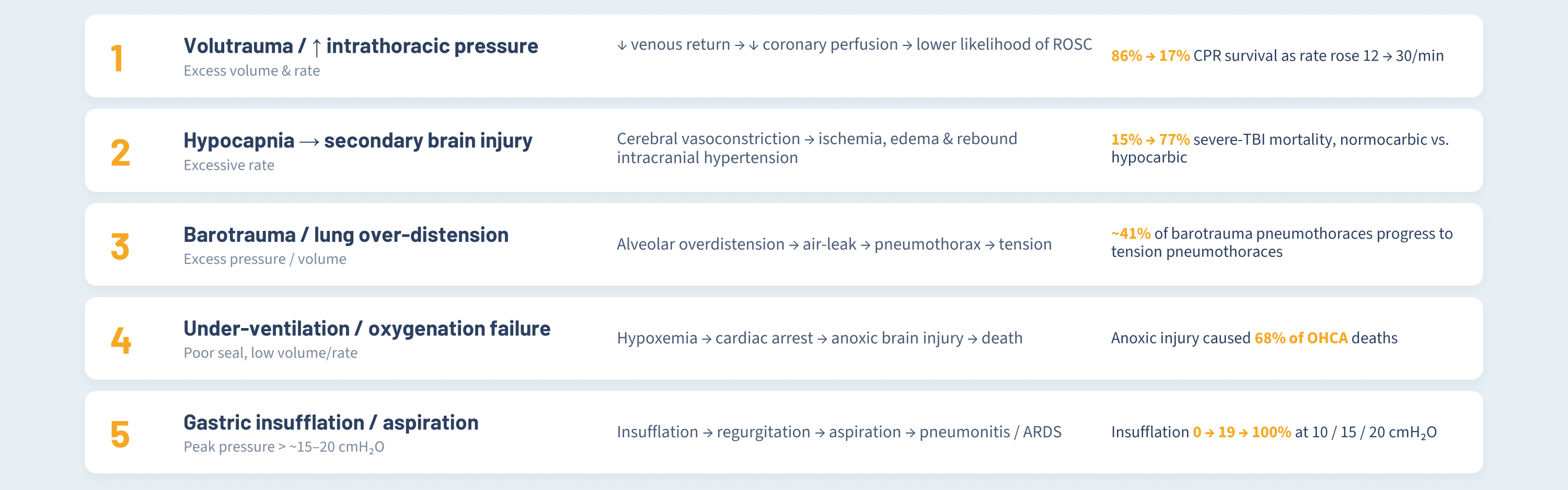
Excessive ventilation rate and volume can increase intrathoracic pressure, reducing venous return to the heart and compromising coronary perfusion during resuscitation. This phenomenon has been well documented in CPR research. Aufderheide and colleagues demonstrated that rescuers commonly hyperventilated, averaging approximately 30 breaths per minute, and showed that excessive ventilation increased intrathoracic pressure and reduced coronary blood flow, adversely affecting survival in experimental models.
2. Hypocapnia and Secondary Brain Injury
Hyperventilation can also drive carbon dioxide levels below physiologic ranges. In patients with severe traumatic brain injury, reduced carbon dioxide causes cerebral vasoconstriction, decreasing cerebral blood flow when the injured brain is most vulnerable. Evidence reviewed by the Brain Trauma Foundation has shown that sustained hyperventilation may worsen neurologic outcomes through this mechanism.
3. Volutrauma and Barotrauma
When excessive volumes or pressures are delivered, the lungs may become overdistended. Emerging literature suggests that manual ventilation may contribute to volutrauma and barotrauma due to inconsistent pressure and volume delivery. While not every excessive breath results in injury, repeated overdistension can increase the risk of air leaks, pneumothorax, and other forms of ventilator-associated lung injury. Importantly, the literature supports describing these mechanisms as contributors to injury risk rather than direct proof of causation in every patient.
4. Under-Ventilation and Oxygenation Failure
The opposite problem can be equally dangerous. Poor mask seal, inadequate ventilation rate, or insufficient tidal volume may result in hypoxemia and inadequate oxygen delivery. If prolonged, oxygenation failure can contribute to cardiac arrest, anoxic brain injury, or death. Maintaining consistent and appropriate ventilation is therefore critical on both ends of the spectrum.
5. Gastric Insufflation and Aspiration Risk
Excessive airway pressure can force air into the stomach rather than the lungs. Studies examining mask ventilation pressures have demonstrated a clear relationship between higher inspiratory pressures and gastric inflation. Gastric insufflation increases the risk of regurgitation, which in turn raises the risk of aspiration and subsequent pulmonary complications. Current American Heart Association guidance specifically warns against excessive ventilation because it can contribute to gastric inflation, aspiration risk, and reduced cardiac output.
Three Decades of Consistent Evidence
The remarkable aspect of the manual ventilation literature is its consistency. From the work of Milander in 1995, through studies involving emergency department instructors, pediatric mock codes, simulation research, respiratory therapists, and now real-world patient data, investigators have repeatedly documented the same problem: clinicians routinely struggle to control ventilation rate, pressure, and volume with a traditional BVM.
This is why organizations such as the NAEMSP emphasize controlling all three variables and recommend two-person BVM ventilation whenever feasible. The challenge is not a lack of knowledge. It is the difficulty of executing precise manual ventilation during stressful, time-sensitive clinical events.
ButterflyBVM™: A New Approach to Reducing Patient Harm During Manual Ventilation
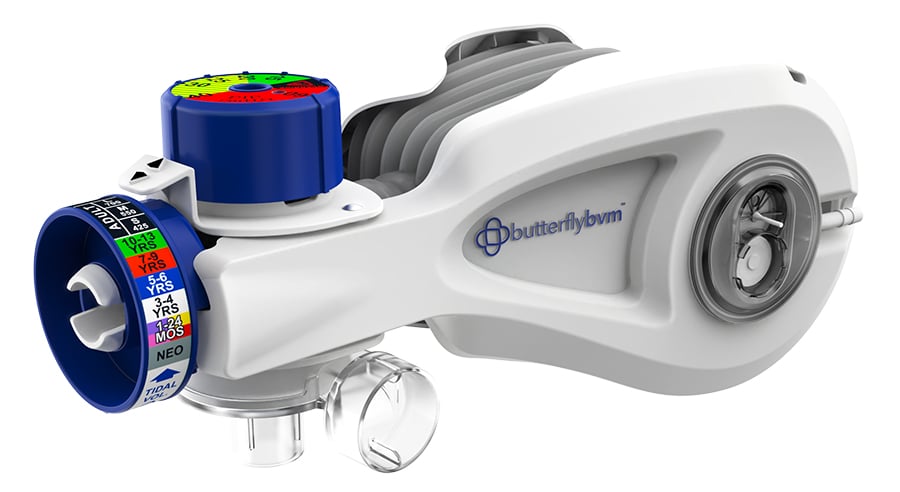
The ButterflyBVM™ was developed to address the root cause of these harms: uncontrolled variability. Rather than relying solely on operator technique, the device incorporates controls for ventilation rate, tidal volume, and peak inspiratory pressure directly into the resuscitator itself. These controls are designed to interrupt the pathways that lead to hyperventilation, lung overdistension, inadequate ventilation, and gastric insufflation.
Independent testing has shown that users of the ButterflyBVM were significantly more likely to remain within target ventilation parameters than users of conventional BVMs, with 10.5 times the odds of staying within the desired range. The goal is not to replace clinical judgment, but to reduce unwanted variability and make guideline-concordant ventilation easier to achieve during high-acuity situations.
As healthcare organizations continue to focus on preventing avoidable patient harm, manual ventilation deserves closer attention. Three decades of evidence suggest that incorrect ventilation is common, measurable, and modifiable. By helping clinicians better control rate, pressure, and volume, the ButterflyBVM represents an important step toward safer, more consistent respiratory support.
Click here for a list of references used in this article.
To request a demonstration or more information about the ButterflyBVM Resuscitator from Compact Medical, contact your local MED Alliance Sales Representative, call 888-891-1200, or email us.
MED Alliance Group is a medical device distributor dedicated to meeting the needs of our clinical customers and manufacturing partners since 1998. We specialize in the sales, marketing, importation, logistics and distribution of innovative, high-quality and cost-effective products found in anesthesia and respiratory, blood and transfusion therapy, EMS and emergency room, interventional radiology and cath lab, iv and vascular, as well as NICU and PICU.
Please follow us on LinkedIn, Facebook and Twitter for MED Alliance product updates.


