
AERIS Airway®: Supporting Deep IV Sedation Patients
When Do You Reach for an OPA or NPA During Deep IV Sedation?
Every anesthesia provider keeps a mental checklist of patients likely to pose airway management challenges under deep IV sedation.
Patients with obesity, obstructive sleep apnea (OSA), difficult airway anatomy, chronic mouth breathing, longer procedural times, or steadily increasing propofol requirements are often the ones for whom clinicians reach for an oropharyngeal airway (OPA) or a nasopharyngeal airway (NPA). Clinicians may choose to use these airways proactively, anticipating difficulty, or reactively, when a routine case becomes more challenging.
That’s Where the AERIS® Airway Belongs
AERIS is not intended for every deep IV sedation patient. Rather, it is a purpose-built, advanced sedation-airway platform designed for patients who require additional airway support. By integrating with the OPA and NPA adjuncts clinicians already use, AERIS combines airway support, enhanced oxygen delivery, and reliable, real-time capnography in a standardized platform. The result reduces the risk of hypoxemia and enhances patient safety in higher-risk patients.
The Challenge with Traditional Oxygen Delivery
Deep IV sedation is a state in which spontaneous ventilation is maintained, but respiratory compromise can occur quickly and unexpectedly. Sedative medications, particularly propofol, can contribute to upper airway obstruction, hypoventilation, and hypoxemia, especially in higher-risk patients.
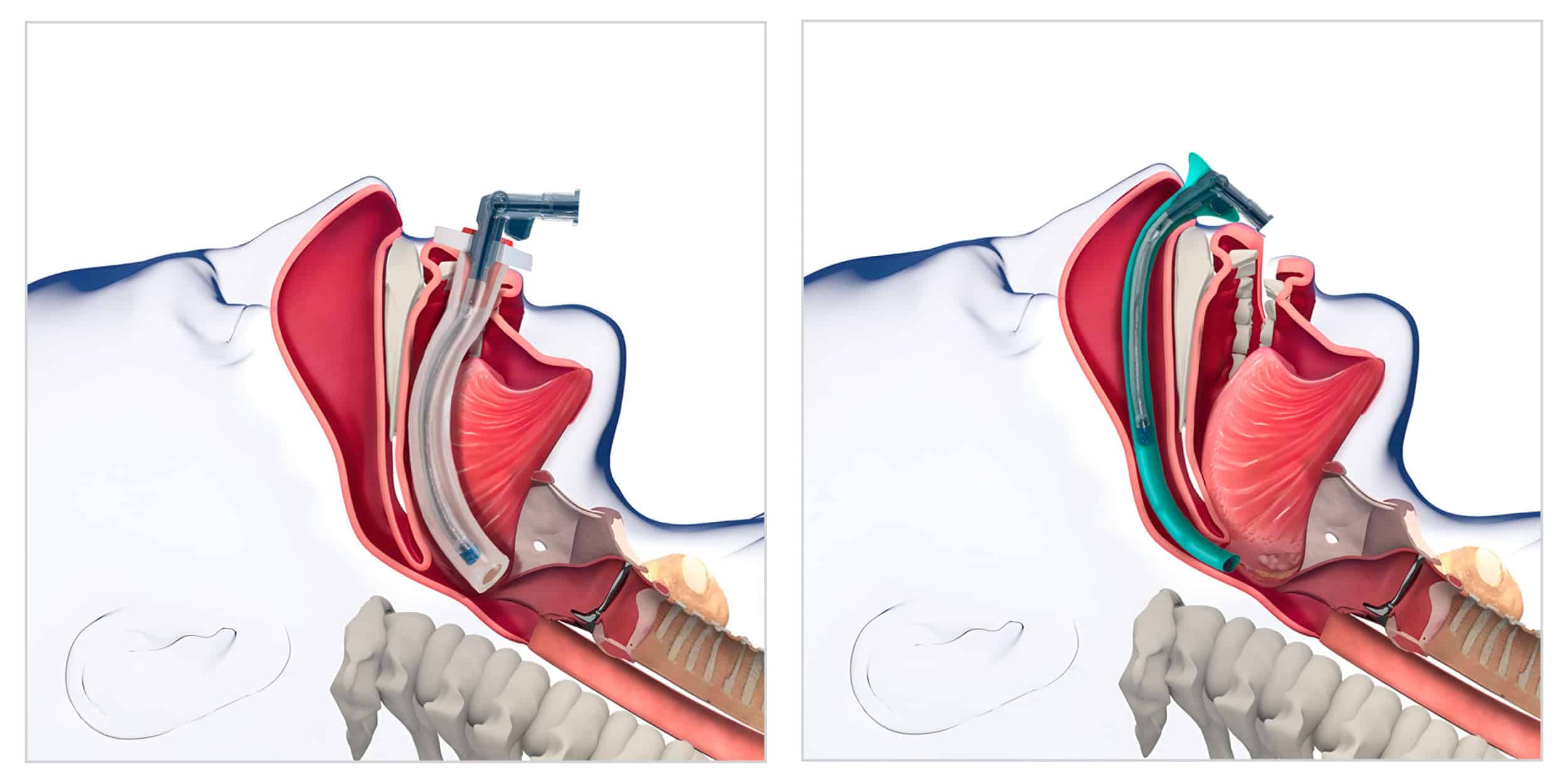
When airway obstruction develops, clinicians frequently insert an OPA or NPA to restore patency — but this addresses only the mechanical obstruction. Effective oxygenation and capnography remain unresolved, because nasal cannulas and face masks deliver oxygen and sample CO₂ at the nasal or oral opening rather than at the supraglottic level. As a result, oxygen is not targeted to the supraglottis, and entrained room air and oxygen flow dilute the CO₂ sample at the nares or face, compromising waveform reliability.
AERIS was developed to address this gap by transforming familiar OPA and NPA devices into integrated oxygen-delivery and ETCO₂-monitoring platforms. The device delivers oxygen directly into the supraglottic space while sampling exhaled carbon dioxide closer to the airway, helping providers monitor respiratory status more effectively during deep sedation.
What the Evidence Shows
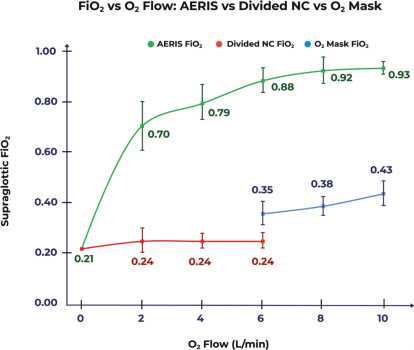
A recently published physiological study compared the AERIS Airway with a divided nasal cannula and a standard oxygen face mask in awake, spontaneously breathing volunteers. Investigators measured oxygen concentration (FiO₂) at the supraglottic level, the area most relevant to oxygen delivery to the lungs.
The results were notable. The AERIS Airway delivered supraglottic FiO₂ levels approximately 2.5 to 3.5 times higher than a divided nasal cannula and approximately 2 to 2.5 times higher than a face mask across clinically relevant oxygen flow rates. The authors concluded that the device produced substantially greater supraglottic oxygen concentrations than conventional oxygen delivery systems.¹
Equally important, AERIS provides continuous capnography via a dedicated sampling port near the distal airway, allowing clinicians to obtain ETCO₂ monitoring closer to the patient’s respiratory tract.¹
AERIS: A Standardized “Step-Up” Airway Strategy
Many providers have experienced cases that began as routine sedation but gradually required escalating airway interventions. The patient begins snoring, oxygen saturation trends downward, airway maneuvers become more frequent, and eventually an OPA or NPA is inserted.
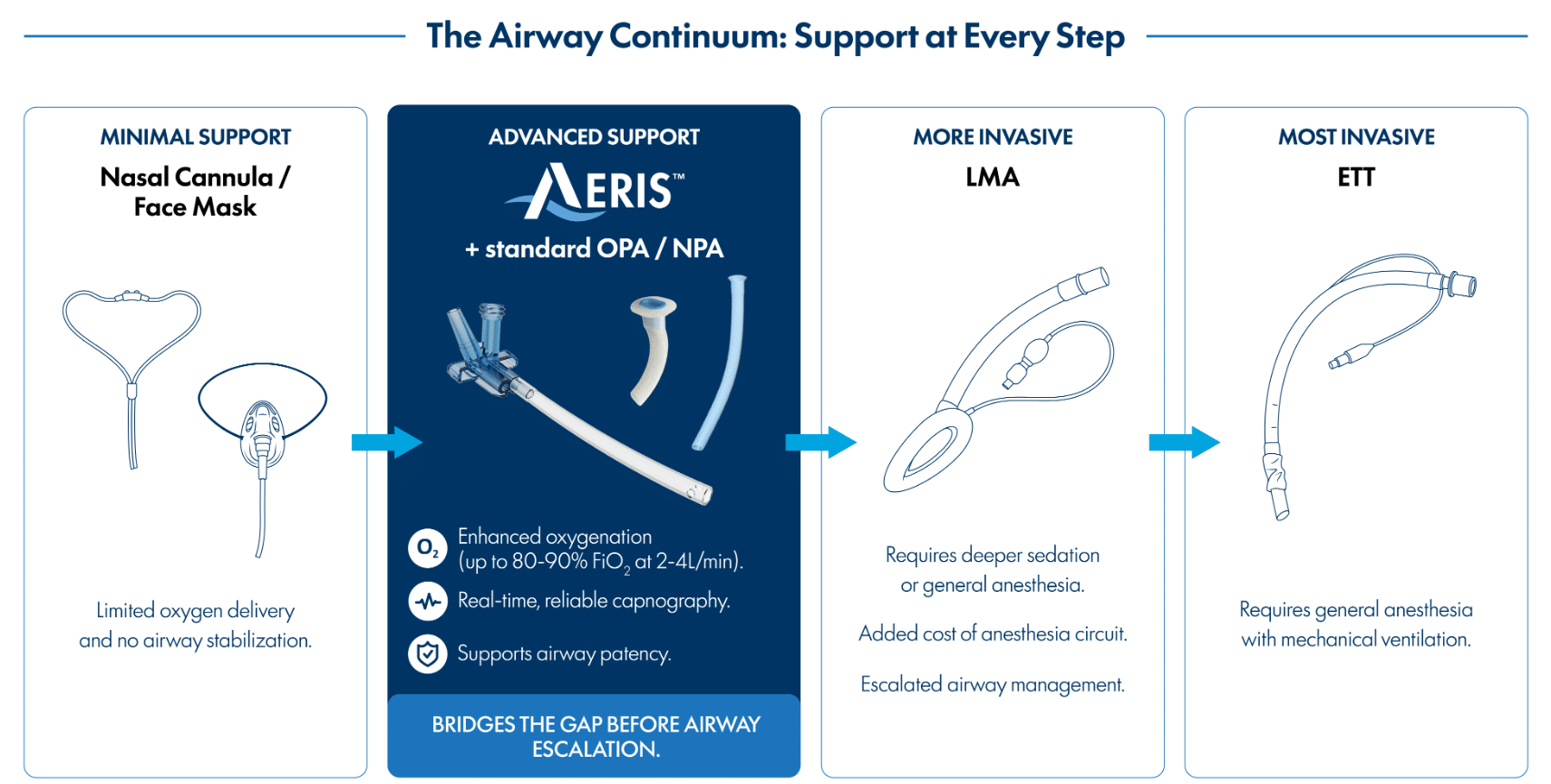
For these patients, AERIS offers a standardized step-up airway solution rather than an improvised workaround. It integrates seamlessly with commonly used OPAs and NPAs, supports spontaneous ventilation, provides direct oxygen delivery, and enables continuous capnography through an FDA-cleared device specifically designed for this purpose.
The question is not whether every patient needs AERIS.
The question is whether the patients who already trigger you to reach for an OPA or NPA could benefit from a more advanced airway platform once you get there.
For patients with obesity, OSA, difficult airway anatomy, mouth breathing, prolonged procedures, or increasing sedation requirements, AERIS represents a logical next step in airway management during deep IV sedation: a purpose-built platform designed to help clinicians oxygenate, monitor, and intervene proactively rather than reactively.
For more information or a demonstration of the AERIS Airway, contact your local MED Alliance Group sales representative, call 888-891-1200 or email us.
Reference:
1. Gonzalez RM. A Physiological Study of Supraglottic FiO₂ With Three Oxygen Delivery Systems During Awake Spontaneous Breathing: Nasal Cannula, Face Mask, and AERIS Airway. A&A Practice. July 2026.
MED Alliance Group is a medical device distributor dedicated to meeting the needs of our clinical customers and manufacturing partners since 1998. We specialize in the sales, marketing, importation, logistics and distribution of innovative, high-quality and cost-effective products found in anesthesia and respiratory, blood and transfusion therapy, EMS and emergency room, interventional radiology and cath lab, iv and vascular, as well as NICU and PICU.
Please follow us on LinkedIn, Facebook and Twitter for MED Alliance product updates.


