
Hospitals Turn to HOB as a New Infection Metric: Stay Ahead with the Orchid SRV™
Healthcare quality metrics are evolving, which impacts how hospitals assess safety, performance, and financial risk. One metric that is rapidly gaining attention is Hospital-Onset Bacteremia and Fungemia (HOB). As healthcare leaders prepare for this shift, it is crucial to understand HOB and explore effective prevention strategies.
What Is HOB?
Hospital-Onset Bacteremia and Fungemia (HOB) refers to the detection of a positive blood culture for a bacterial or fungal pathogen on or after Day 4 of a patient’s hospital stay. (1)
Unlike older metrics that concentrate on specific sources of infection, HOB encompasses a wider range of bloodstream infections acquired during hospitalization. Traditionally, hospitals have focused primarily on central line-associated bloodstream infections (CLABSI); however, this approach overlooks a key issue: 78% of HOB cases are not related to central lines. (2)
This indicates that most hospital-acquired bloodstream infections originate from other sources, making CLABSI-only tracking insufficient for effective infection prevention in modern healthcare settings.
Why Hospitals Are Shifting to HOB
Clinical realities and regulatory changes are driving the shift to HOB.
A More Comprehensive Measure of Patient Safety
HOB offers a holistic view of bloodstream infections by capturing cases that fall outside traditional monitoring frameworks. This allows hospitals to better understand and address the true scope of hospital-acquired infections.
Regulatory Evolution
The Centers for Medicare & Medicaid Services (CMS) is expanding its approach, moving beyond a limited list of hospital-acquired conditions to expand Healthcare-Associated Infection (HAI) programs to include all bacteremia and fungemia events. (2)
Patient Outcome Implications
There is a 13.2% 30-day mortality rate associated with HOB, (3) increasing the average length of stay to 15.6 days. (2) For hospital leaders, this makes HOB both a quality-of-care issue and a patient safety concern.
When Are Hospitals Making the Shift?
The transition is already underway. Regulatory trends and CMS program expansions indicate that HOB is moving from an emerging measure to a standard expectation.
Hospitals that take proactive steps to monitor and address HOB now will be significantly better positioned as reporting requirements and reimbursement models catch up.
The Financial Cost of High HOB Rates
HOB isn’t just clinically significant; it’s financially impactful. A single non-CLABSI HOB event can cost approximately $34,243 (without ICU stay). (2) For a mid-sized 400-bed hospital, this can translate to $2.07 million in annual losses.
These costs stem from extended hospital stays, additional treatments and diagnostics, potential reimbursement penalties and increased operational strain.
As HOB becomes a regulated metric, hospitals with high rates may also face future financial penalties and reductions in performance-based reimbursement.
The Hidden Driver: Peripheral IV Catheters (PIVCs)
One of the most commonly overlooked contributors to HOB is the peripheral IV catheter (PIVC). For every 555 PIVCs inserted, one bloodstream infection occurs. (4) The risk of infection increases dramatically after the fourth day of catheter dwell time, with catheters left in place beyond that time carrying an 8.5 times higher infection risk. (5)
Mechanical factors also contribute to this risk. For instance, IV dislodgement and movement, also known as pistoning, can introduce bacteria into the bloodstream. Notably, 95% of clinicians identify dislodgement as a significant safety risk. (6)
These factors underscore the importance of effective vascular access management as a critical, but often underappreciated, component of HOB prevention.
A Safety Device To Help Prevent HOB: The Orchid SRV™
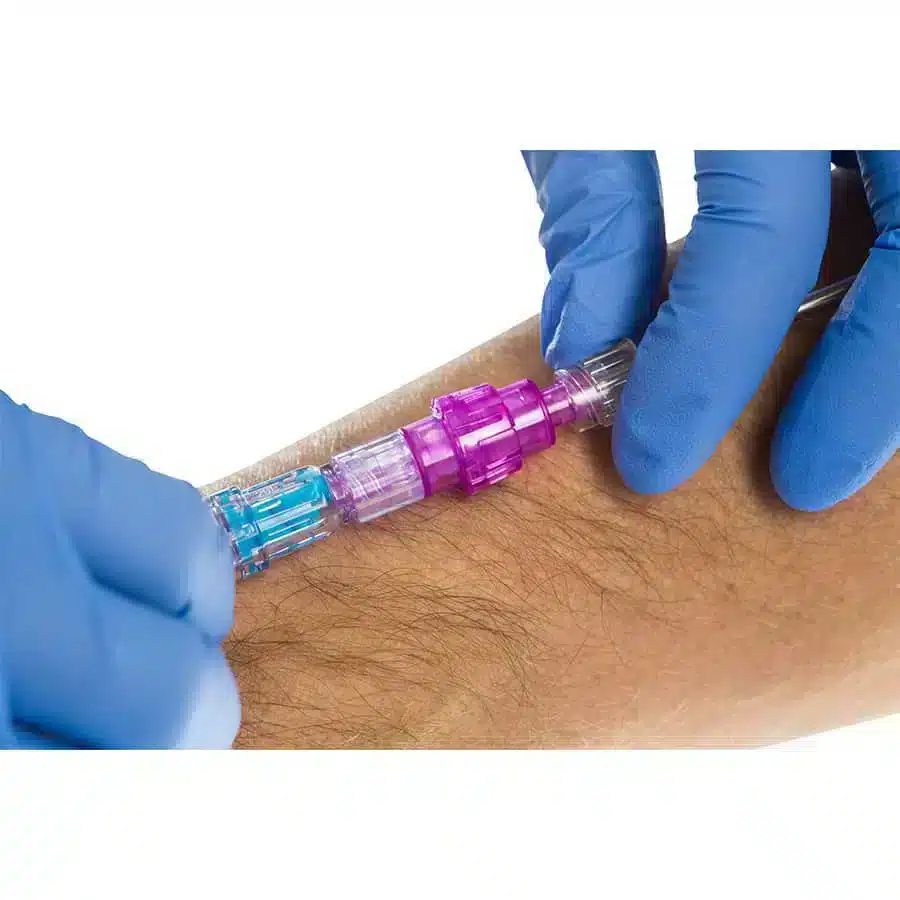
The Orchid SRV™ is an effective and scalable solution designed to help reduce IV line dislodgement and complications from catheter movement, both of which can contribute to HOB.
The Orchid SRV is a force-activated safety device designed to help protect IV lines from accidental dislodgement and other complications due to catheter movement. By reducing the need for IV restarts and reducing catheter movement, the risk of pathogens entering the bloodstream is minimized.
Traditional securement methods can fail up to 50% of the time. (7) The Orchid SRV introduces a force-activated tension-relief mechanism that breaks away and seals both sides before the catheter dislodges, helping to prevent movement that can result in bacteria entering the bloodstream.
This solution requires minimal training, making it easier for already strained nursing teams to adopt and integrate into existing workflows.
When used as part of an infection prevention bundle, studies have shown that primary bacteremia can be reduced by 37%, saving nearly $240,000 annually in hospital costs. (8)
Preparing for the Future of Infection Prevention
The transition to HOB represents a fundamental shift in how hospitals assess and ensure patient safety. It highlights a broader reality: infection prevention must encompass the entire continuum of care, not just central line protocols.
Orchid SRV™ is an impactful tool to help hospitals improve outcomes, reduce costs, and enhance their preparedness for the next wave of quality measures.
To learn more about the Orchid Safety Release Valve or to request an evaluation, call 888-891-1200 or email us to be connected to a local representative.
MED Alliance Group is a medical device distributor that has been meeting the needs of our clinical customers and manufacturing partners since 1998. We specialize in the sales, marketing, importation, logistics and distribution of innovative, high-quality and cost-effective products found in anesthesia and respiratory, blood and transfusion therapy, EMS and emergency room, interventional radiology and cath lab, iv and vascular, NICU/PICU and pharmacy.
Please follow us on LinkedIn, Facebook and Twitter for MED Alliance product updates.
References:
- Centers for Disease Control and Prevention. Hospital-Onset Bacteremia and Fungemia (HOB) Surveillance Protocol. National Healthcare Safety Network (NHSN), 2024.
- Yu KC, Jung M, Ai C, et al. Characteristics, costs, and outcomes associated with central-line–associated bloodstream infection and hospital-onset bacteremia and fungemia in US hospitals. Infect Control Hosp Epidemiol. 2024;45(3):286–295.
- Saliba P, Hornero A, Cuervo G, et al. Interventions to decrease short-term peripheral venous catheter-related bloodstream infections: impact on incidence and mortality. J Hosp Infect. 2018;100(3):e178–e186.
- Mermel LA. Short-term peripheral venous catheter-related bloodstream infections: a systematic review. Clin Infect Dis. 2017;65(10):1757–1762.
- Buetti N, Abbas M, Pittet D, et al. Dwell Time and Risk of Bloodstream Infection With Peripheral Intravenous Catheters. JAMA Netw Open. 2025;8(4):e258305.
- Moureau NL. Impact and Safety Associated with Accidental Dislodgement of Vascular Access Devices: A Survey of Professions, Settings, and Devices. J Assoc Vasc Access. 2018;23(4):203–215.
- Helm RE, Klausner JD, Klemperer JD, Flint LM, Huang E. Accepted but unacceptable: peripheral IV catheter failure. J Infus Nurs. 2015;38(3):189–203.
- DeVries M, Mancos PS, Valentine MJ. Reducing Bloodstream Infection Risk in Central and Peripheral Intravenous Lines: Initial Data on Passive Intravenous Connector Disinfection. J Assoc Vasc Access. 2014;19(2):87–93.


