
Top 10: What Clinicians Really Want to Know About The HORSESHOE™ Airway Security Device
Clinicians Ask Great Questions About the HORSESHOE™
The HORSESHOE™ airway security device is generating real interest among clinicians, and for good reason. It’s the only face-free airway security device designed to secure the endotracheal (ET) tube without relying on facial contact points for securement or requiring adhesive or tape. Its design maintains access for oral care, provides a consistent application technique across shifts and departments, and maintains ET tube securement with patient comfort in mind.
That different approach naturally comes with questions. Here are some of the ones we hear most often.

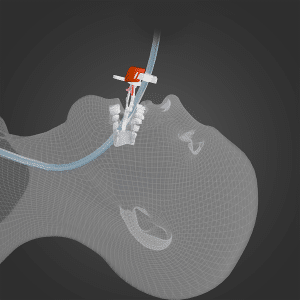

What is the HORSESHOE, and why does it look so different?
The HORSESHOE is designed to secure an oral endotracheal tube without relying on the patient’s face for attachment. The device is supported at the posterior dentition and stabilizes the ET tube without facial tape or adhesive-based securement.
The concept originated with two U.S. Army Respiratory Therapists at Brooke Army Medical Center, who developed the original design in response to challenges securing ET tubes in patients with significant facial injuries.

How is the HORSESHOE different from tape or a strap-based holder?
Traditional securement methods rely on attachment to or contact with facial skin. The HORSESHOE uses an intraoral approach instead.
Its design integrates ET tube securement and bite protection while maintaining access to the face and oral cavity for inspection, suctioning, and routine oral care.

Has it been used clinically?
Yes, it is in active use. One notable example is a pilot study in adult burn surgery patients at Massachusetts General Hospital. In that pilot, investigators observed no unplanned tube dislodgements and no device-related oral or lip pressure injuries. Clinicians also reported favorable usability ratings, including access to oral care and suctioning.

How long can one device stay in place?
The HORSESHOE is designed to remain in place for the life of the ET tube, up to 30 days. If the ET tube is changed sooner, a new HORSESHOE should be applied with the new tube.

What about patients at risk for agitation or self-extubation?
The HORSESHOE includes a Supplementary Head Strap designed to provide additional device stabilization when used as directed in the Instructions for Use. As with any airway securement method, patient-specific factors—including agitation, delirium, movement, and risk of self-extubation—should continue to be assessed and managed in accordance with institutional airway-management protocols and clinical judgment.

Does the posterior pressure hurt the jaw or TMJ?
The HORSESHOE is intentionally designed to distribute support at the posterior dentition. Molars have multiple roots and a larger supporting surface than anterior teeth, making them well suited to bear occlusal loads. Research on jaw mechanics also supports posterior rather than anterior loading as a more favorable configuration for the temporomandibular joint compared with anterior loading, such as that associated with traditional bite-block designs.

What about patients with facial hair, burns, trauma or facial swelling?
Because the HORSESHOE does not rely on facial adhesives or tape for securement, it does not depend on clear, hairless, or intact facial skin for application. This makes its face-free design particularly relevant when facial access is important or when facial hair, burns, trauma, edema, or other skin conditions can make adhesive-based securement challenging.

What if a patient is missing molars or has limited mouth opening?
One suitable molar on each side can provide the bilateral support needed for device placement. When posterior support is limited, the Supplementary Head Strap can provide additional device stabilization. As with any airway securement method, clinicians should assess each patient’s dentition and anatomy before placement, particularly when mouth opening is significantly restricted.

Does it get in the way of oral care?
The HORSESHOE is designed to maintain access to the oral cavity while the ET tube remains secured. Its open configuration allows access for routine activities such as oral inspection, suctioning, and toothbrushing. The ET tube can also be repositioned side-to-side, allowing care teams to access different areas of the mouth and accommodate oral-care and suction devices without removing the securement device. By contrast, limited oral access with conventional securement can make routine oral care more challenging and may contribute to delayed or missed care.

Can the ET tube be repositioned once in place?
Yes. The HORSESHOE incorporates an adjustable clamp that moves along a continuous track, allowing clinicians to reposition the ET tube laterally without removing the entire device. Unlike fixed-position designs, the track has no predetermined stops, giving clinicians flexibility to position the tube where clinically appropriate. To reposition the tube, clinicians unlock the clamp, move the ET tube laterally to the desired position, reconfirm tube depth and position according to institutional protocol, and relock the clamp.
Have questions of your own? Contact your local MED Alliance Group sales representative, call 888-891-1200 or email us for more information or a demonstration of the HORSESHOE airway security device.
MED Alliance Group is a medical device distributor that has been dedicated to meeting the needs of our clinical customers and manufacturing partners since 1998. We specialize in the sales, marketing, importation, logistics and distribution of innovative, high-quality and cost-effective products found in anesthesia and respiratory, blood and transfusion therapy, EMS and emergency room, interventional radiology and cath lab, iv and vascular, as well as NICU and PICU.
Please follow us on LinkedIn, Facebook and Twitter for MED Alliance product updates.


