
The HORSESHOE™: Addressing the Biggest Challenges in Airway Securement
Ensuring a secure airway goes beyond just holding an endotracheal (ET) tube in place. Respiratory therapists, anesthesiologists, intensivists, and critical care nurses consistently work to prevent complications like tube dislodgement, infection, and airway or tissue injury.
Unfortunately, traditional solutions often rely on tape, adhesives, or straps applied directly to the face. Still, these methods can introduce their own challenges, including facial pressure injuries, compromised access for oral care, and increased complexity when repositioning or maintaining the airway.
The HORSESHOE™ is the only face-free airway security device designed to address these issues by securing the airway from within the mouth and leveraging the patient’s jaw biomechanics, rather than relying on the face. This innovative design enhances tube stability, maintains access to the oral cavity, and ultimately improves patient outcomes by reducing facial contact and supporting daily care practices.
The HORSESHOE Offers A Different Approach: A Face-Free Design
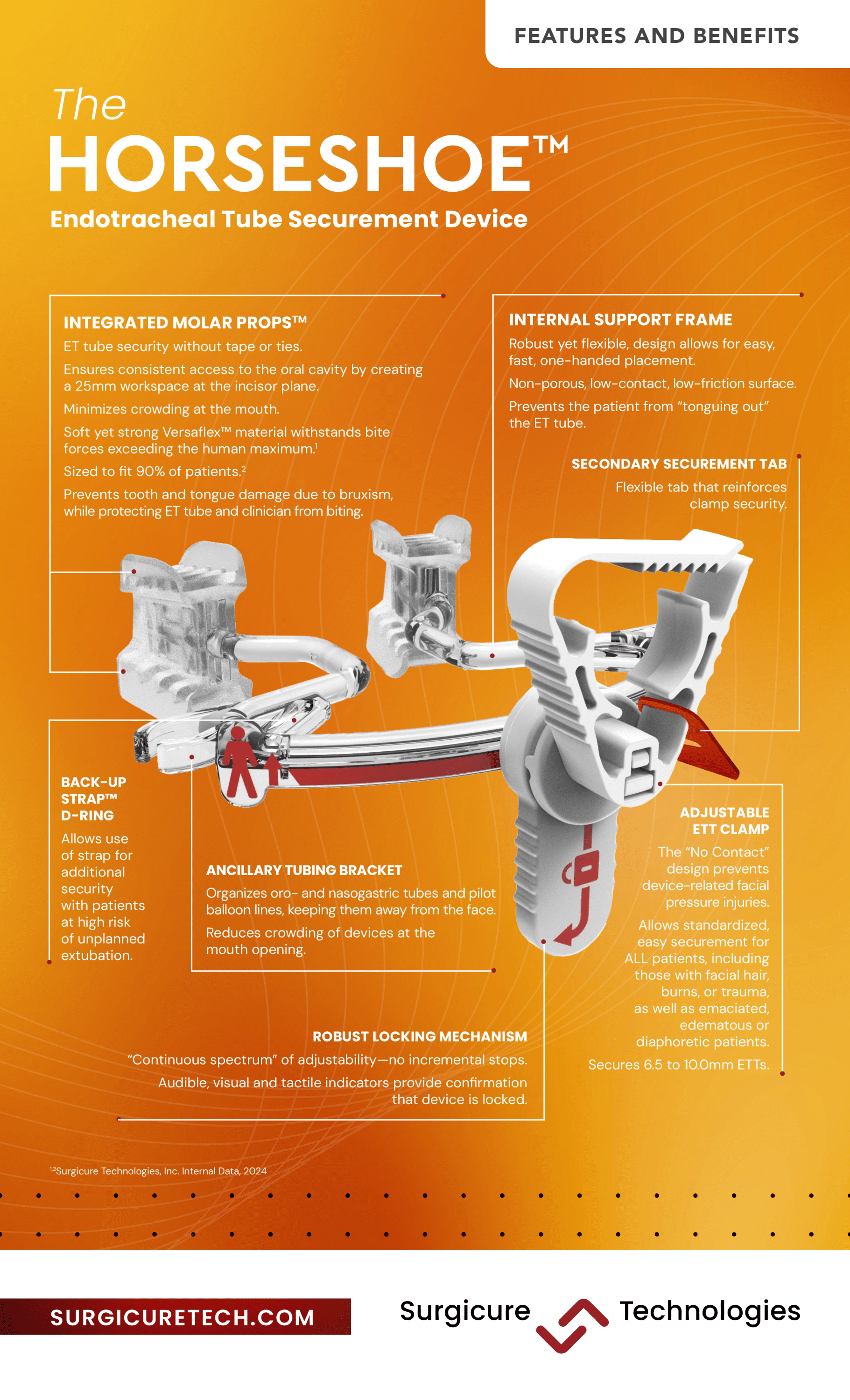
At the heart of the HORSESHOE is its “off-the-face” design. Unlike traditional fixation methods that rely on the face as an anchor point, the HORSESHOE secures the airway intraorally using integrated Molar Props™ positioned on the posterior teeth. By shifting securement away from the lips, cheeks, and facial skin, the device minimizes the risk of device-related facial pressure injuries while maintaining reliable tube stability.
This design is particularly valuable for patients with fragile skin, facial burns, trauma, edema, diaphoresis, or facial hair, where adhesives and facial securement methods may fail or create additional complications. The result is a more universal solution that can be standardized across a broad patient population.
Integrated Molar Props: Securement Using the Body’s Strongest Foundation
One of the most innovative features of the HORSESHOE is its Integrated Molar Props™. These soft yet durable components rest along the molars, utilizing one of the strongest and most stable areas of the jaw to secure the device. Rather than working against the patient’s anatomy, the design leverages natural jaw physiology and resting bite forces to help maintain position. Read the Jaw Physiology Whitepaper.
The benefits extend beyond securement:
- Eliminates reliance on facial tape or ties.
- Reduces the risk of patients “tonguing out” the ETT.
- Protects the tube, patient, and caregiver from bite-related complications.
- Helps prevent tongue and tooth damage associated with bruxism.
- Accommodates the vast majority of adult patients.
- Withstands bite forces that exceed normal human maximums.
For clinicians, this creates a more dependable airway stabilization platform. For patients, it reduces the need for facial fixation methods that can contribute to skin breakdown and discomfort.
Creating Space for Better Oral Care
Oral care is a critical but often challenging component of managing intubated patients. Traditional securement devices can crowd the mouth, making access for suctioning, oral hygiene, and routine assessment more difficult.
The HORSESHOE was intentionally designed to create a consistent 25 mm workspace at the incisor plane. By positioning the Molar Props™ posteriorly, clinicians gain unobstructed access to the oral cavity without compromising tube security.
This design offers several caregiver advantages:
- Easier access for oral hygiene procedures.
- Improved suctioning access.
- More efficient assessment of oral tissues.
- Simplified ETT repositioning when clinically indicated.
- Reduced crowding around the mouth.
Better oral access supports consistency in oral care protocols, which contributes to overall patient safety and quality of care.
Adjustable ETT Clamp: Flexibility Without Compromise
The HORSESHOE features an infinitely adjustable ETT clamp mounted on a cantilevered track. This design allows caregivers to precisely position the tube without creating pressure on the lips or surrounding facial structures.
Unlike systems limited by predefined adjustment points, the HORSESHOE provides a continuous spectrum of positioning options. Clinicians can easily move the tube laterally or medially to relieve pressure points and accommodate patient-specific anatomical needs.
The clamp secures ETTs ranging from 6.5 mm to 10.0 mm, providing versatility across a wide range of adult airway management scenarios.
Robust Locking Mechanism Designed for Confidence
In critical care environments, confidence in tube securement is essential. The HORSESHOE’s locking mechanism was engineered to provide multiple forms of confirmation that the tube is secure.
The system incorporates:
- Audible confirmation.
- Visual confirmation.
- Tactile confirmation.
These layered indicators help caregivers verify proper device engagement quickly and consistently, reducing uncertainty during placement and routine assessment.
Additionally, a secondary securement tab reinforces clamp stability, providing another layer of protection against accidental movement.
Internal Support Frame: Strength and Patient Comfort
The internal support frame balances rigidity and flexibility, enabling fast, one-handed placement while maintaining structural integrity. Its low-contact, low-friction, non-porous surface helps reduce shear forces and minimizes unnecessary tissue interaction.
From a patient perspective, the materials used in the HORSESHOE have been evaluated for prolonged mucosal contact and comply with ISO 10993 biocompatibility standards. The device is latex-free, non-cytotoxic, and designed to reduce friction and pressure within the oral cavity.
Organized Airway Management Through Ancillary Tubing Control
Managing multiple tubes and lines around the airway can be challenging. The HORSESHOE addresses this with an integrated Ancillary Tubing Bracket that organizes oro- and nasogastric tubes as well as pilot balloon lines.
This feature helps:
- Reduce clutter at the mouth opening.
- Improve visibility.
- Streamline caregiver workflow.
- Keep tubing away from the face.
Small workflow improvements like these can have a meaningful impact on efficiency during routine care and emergency interventions.
Backup Strap D-Ring: Supplemental Securement When Needed
Although the HORSESHOE’s primary design philosophy avoids dependence on facial securement, the device includes a Backup Strap™ D-Ring for situations that require additional stabilization.
For patients at elevated risk of unplanned extubation or during transport, clinicians can add supplemental securement based on clinical judgment while still benefiting from the device’s face-free design.
The Outcome: Better Protection, Better Access, Better Care
The HORSESHOE airway security device represents more than a new securement method. It reflects a shift in thinking about airway management. By moving securement away from the face and leveraging natural jaw anatomy, the device helps reduce pressure injury risk, improve airway stability, maintain access for oral care, and simplify workflow for clinicians.
The HORSESHOE’s design innovations support the ultimate goal of every airway management strategy: safer care and better outcomes.
For more information or an evaluation of the HORSESHOE airway security device, contact your local MED Alliance Group sales representative, call 888-891-1200 or email us.
MED Alliance Group is a medical device distributor that has been dedicated to meeting the needs of our clinical customers and manufacturing partners since 1998. We specialize in the sales, marketing, importation, logistics and distribution of innovative, high-quality and cost-effective products found in anesthesia and respiratory, blood and transfusion therapy, EMS and emergency room, interventional radiology and cath lab, iv and vascular, as well as NICU and PICU.
Please follow us on LinkedIn, Facebook and Twitter for MED Alliance product updates.


